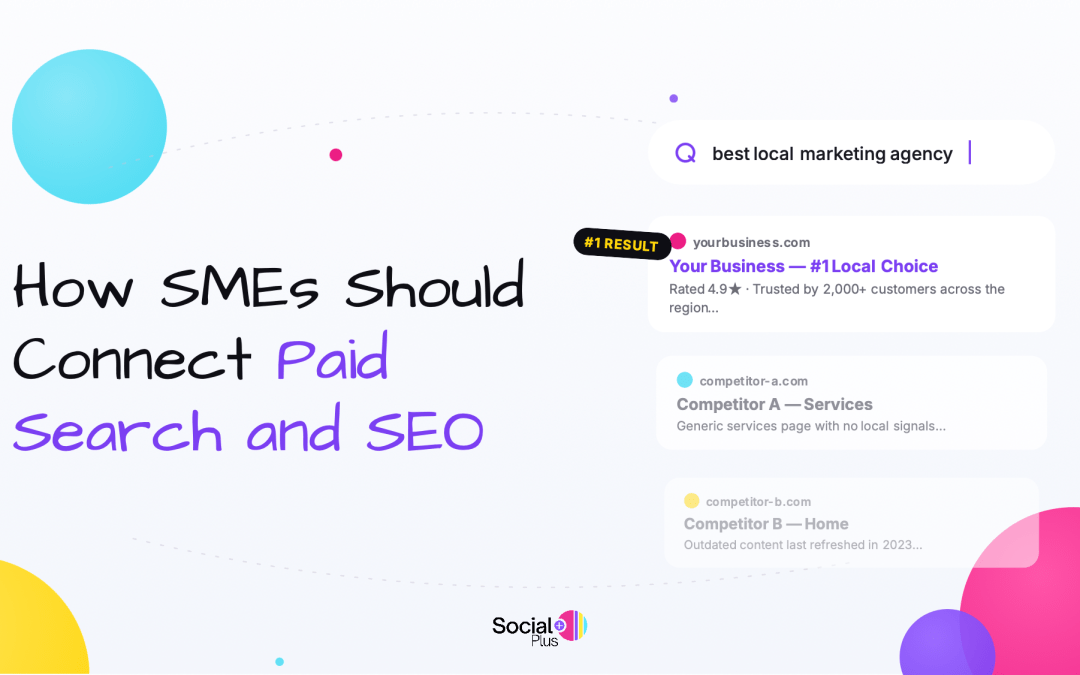
Most SMEs run paid search and SEO as if the two channels have nothing to do with each other. They sit in different reports, often handled by different people or different agencies, and the data each one produces rarely gets read across the channel boundary. The fastest way to improve both is to connect paid search and SEO so each one informs the other. Read on for what paid search data tells your SEO strategy, what SEO data tells your paid search, and two moves any SME can run this quarter to see the difference.
The Case for Paid Search and SEO Talking to Each Other
Both channels are answering the same question: what are people searching for when they are ready to buy from you. Paid search gives you that answer quickly, at a cost. SEO gives you the same answer for free, but only for the queries you already rank for. Run them separately and you pay twice for the same insight, often pulling in opposite directions. Run them together and the spend on each channel sharpens the other.
This is not new thinking, but it remains uncommon practice. At BrightonSEO, Everest Nwagwu’s talk on integrating paid search and SEO made the case directly: the top-performing PPC headlines are the best candidates for organic H1s, and the top-performing PPC keywords often map to high-intent SEO opportunities that organic strategy is ignoring.
The same logic now extends into AI search. As we covered in our piece on answer engine optimisation in 2026, AI Overviews increasingly cite the same proven, specific phrasing that wins in paid. Treat the channels as one and you feed both the SERP and the AI answer at once.
What Paid Search Data Tells Your SEO Strategy
Three specific things.
Your top-CTR ad headlines are tested H1s
If a headline is winning clicks against paid competitors, it has earned its place. Use it, or a close variant, as the H1 or above-the-fold proposition on the matching landing page. The work of finding language that converts has been done. Don’t make SEO start over.
Your top-converting search terms are content briefs
Pull the Search Terms report in Google Ads. If a term is converting in paid but you don’t rank for it organically, you have a content opportunity. Either you don’t have a page on the topic, or the page you have isn’t optimised for that exact phrase.
Your wasted spend is your over-cannibalisation signal
If you are paying for clicks on terms you already rank in the top three for, you are often buying clicks you would have got for free. Overlay the Search Terms report with Search Console and the picture becomes clear.
What SEO Data Tells Your Paid Search
The flow runs both ways.
Your top organic pages reveal high-intent language
The queries Search Console shows your best-converting organic pages ranking for are queries that already turn into customers. Test those exact phrases as paid search ad copy. They are pre-tested by the search engine on your behalf.
Your high-impression, low-position queries are paid search candidates
Search Console shows queries getting impressions on page two or three. If they are commercially valuable, paid search can buy you to the top while you work on the organic position.
Your branded organic traffic is a paid search budget question
If you already capture heavy branded organic traffic, you may not need to defend the brand term in paid search. If a competitor is bidding on your name, that calculation changes.
Two Moves Any SME Can Run This Quarter
The simplest integration takes one afternoon.
1. PPC headlines into SEO
Open Google Ads. Pull the top five ads by CTR over the last 90 days. For each, find the matching landing page and check the H1. If the H1 is less specific or less convincing than the ad headline, change it. Thirty minutes of work, with wins that compound across months.
2. PPC keywords into SEO
Open the Search Terms report in Google Ads. Filter for converting terms. Cross-reference with Search Console. Any converting term where you don’t rank in the top 10 organically is a content brief. Write it.
The table below makes the loop explicit.
| What paid search teaches SEO | What SEO teaches paid search |
|---|---|
| Top-CTR ad headlines = tested H1s | Top organic queries = proven ad copy |
| Converting search terms you don’t rank for = content briefs | High-impression page-2 queries = paid search candidates |
| Wasted spend on terms you rank top-3 for | Strong branded traffic = lower brand-term ad spend |
Why the Two Usually Get Run Separately
Most of the time it just works out this way, and it is rarely a deliberate choice. You might have two agencies, two contracts and two invoices, or one person looking after both with little time to join them up. Connecting the two is not actually the hard part. The hard part is that no one is clearly in charge of it. In the SME accounts we audit, this is the gap we see most often.
It does not help that the two are usually paid for from different budgets, with different targets and different people reporting on them. So nobody is really looking at how they work together, and the obvious links between them quietly go unmade. Joining them up tends to need someone who can see the whole picture.
Usually the only person who sees that whole picture is the business owner. If you do not ask for the two to be joined up, it often will not happen on its own. That is not a failing on your part. It is simply how most setups are built.
When It Is Worth Connecting the Two
Here is a simple way to check. If you are paying for both paid search and SEO, but could not quickly say what one is telling you about the other, that is usually a sign it is time to bring them together.
It matters most when a few things are true at the same time. You are spending more than around £500 a month on paid ads, you already have a few pages showing up on Google on their own, the same customers are searching in both places, and the two are being run by different agencies or freelancers who rarely talk to each other.
It matters less if you are only just getting started with both, if you only run one of them, or if the people clicking your ads are after something quite different from the people who find you on Google.
How to Make Integration Stick
One report. One person responsible. One monthly review.
The report shows the cross-channel data on one screen. The person is whoever can change either side, or instruct the people who do. The review is short, no more than 30 minutes, and answers two questions: what did paid teach organic this month, and what did organic teach paid.
Anything more complicated than that and it gets dropped.
Making Search Work Harder for Your Business
Paid search and SEO are not separate jobs. They are two views of the same conversation, and the SMEs who treat them that way get more from a smaller budget than the ones who don’t. Two moves this quarter (PPC headlines into SEO, PPC keywords into SEO) will tell you more about your customers’ search behaviour than any third-party tool will.
If you are spending money on both channels and want a second set of eyes, request a free digital marketing audit and we will look at how your Google Ads and your SEO are currently talking to each other, and where they should be.